

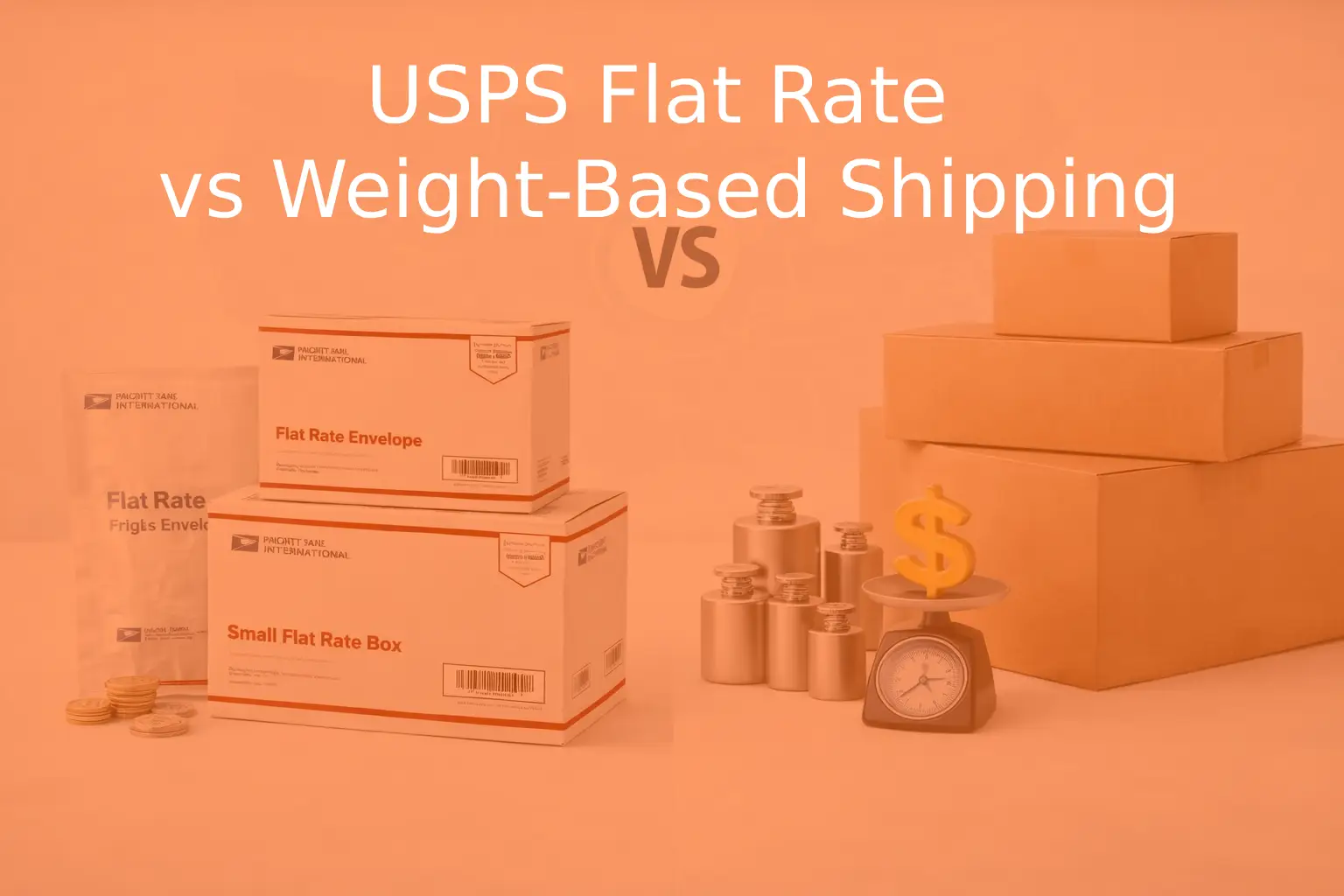



Weight-based service and flat-rate packaging are two types of services that are adopted by shipping carriers to calculate shipping expenses and offer cost-saving services to customers. The choice is primarily determined by two factors, the weight of your package and the distance that it covers. Flat rate pricing does not change depending on weight (up to 70 lbs) or the destination zone, making it an ideal choice for heavier parcels and long-distance deliveries.
However, Weight-based shipping pricing based on weight and shipping zone can make it cheaper when using lightweight packages and when the delivery is done in a close range. Most companies fail in their businesses just because they use the same method in all their shipments without comparing them. This guide is an explanation of the actual differences, box size, and zone distributions, in order to have a clear picture of when Flat Rate is going to save money and when weight-based pricing will be the smartest decision.
Comparisons of USPS Flat Rate Packaging and Weight-Based Shipping
These are both services that are provided through the United States Postal Service Priority Mail. The difference depends on how the price is calculated. Flat Rate charges the same amount regardless of the weight (up to 70 lbs) or zone. Whereas the Weight-Based Price varies according to weight, size, and destination zone.
The following are the main factors that you need to compare before you make a decision.
- Package weight
- Shipping zone (distance)
- Package size and dimensions
- Box type restrictions
- Cost predictability
- Flexibility in packaging
- Break-even weight points
- Heavy and dense shipment
- Lightweight shipment advantage
- Dimensional limits
- Maximum weight allowed
- Business volume and automation
Here, we are going to compare each of these factors side-by-side.
1. Package Weight
In the case of Flat rate Shipping, the rate is constant for packages of a weight of up to 70 lbs, provided they can fit into the allowed box or envelope. This is particularly useful with heavy and dense items since the price is not dependent on weight.
On the contrary, weight-based postage is based on the weight of the package. The more weight, the higher the cost of shipping. This approach is ideal for the lightweight packages, particularly those that are below 3-4 pounds.
Final Choice:
Flat Rate tends to be cheaper when your package is heavy. In case it is lightweight, the weight shipping is usually cheaper.
2. Shipping Zone (Distance)
The United States Postal Service subdivides deliveries into Zones 1 to 9, depending on the distance between the origin and the destination. Flat rate pricing does not vary depending on the zone, and hence, it is perfect for cross-country or long-distance shipments.
The shipping zone affects the weight-based pricing, whereby close shipments (Zones 14) are likely to be priced significantly lower than extended distances.
Final Choice:
Flat Rate can be a better option in long-distance shipments. In the case of short distances, the weight-based delivery costs less.
3. Package Size and Dimensions
Flat Rate shipping involves the use of official USPS packaging. The product should be placed correctly so that it does not stick out of the box. Common options include:
- USPS Priority Mail Flat Rate Small Box
- USPS Priority Mail Flat Rate Medium Box
- USPS Priority Mail Flat Rate Large Box
- Flat Rate Envelopes (legal and regular)
Weight-based shipments enable you to pack your own package, provided that the girth of the package is not more than 108 inches. This provides greater flexibility, particularly for odd-shaped or custom-sized items.
Final Choice:
When your product can perfectly fit into a Flat Rate box, you can save money. When you require flexibility in your packaging, then weight-based shipping is preferable.
4. Cost Predictability
The price of the flat rate is constant, and therefore it is easier to plan shipping costs and also easier to budget these costs. The identical box will always be of the same price, irrespective of weight or distance.
Shipping by weight is price-dependent on weight and zone, which may make prices less predictable, unless shipping software or rate comparison programs are used.
Final Choice:
Flat Rate is best when you prefer a straightforward and predictable price. Weight-based is the best option if you prefer an accurate price per shipment.
5. Break-Even Weight Points
Break-even points are those points at which one option becomes less expensive than the other. In the case of the Small Flat Rate Box, short-distance shipments of less than 1 lb are typically cheaper using weight-based pricing. Nevertheless, Flat Rate is usually cheaper for packages of 2 lbs or longer distances.
In the case of the Medium Flat Rate Box, the cost of shipping a package with a weight of less than 5 lbs in Zone 1-4 is often lower with weight-based rates. At 6-7 lbs of weight in Zones 5-9, the flat rate is usually cheaper. Flat Rate is generally cheaper in all zones when it comes to 16 lbs or above.
The weight-based pricing can be applied to the Large Flat rate Box shipments that weigh less than 20 lbs and fall under Zones 1 through 4. However, after 25 lbs, the flat rate will be less expensive in all zones.
Final Choice:
The greatest savings occur in knowing the break-even weight of the shipment you have.
6. Maximum Weight Limits
Both Flat Rate and weight-based Priority Mail shipments can not exceed 70 lbs and must adhere to USPS size requirements. In case your package is larger than these limits, you will have to select another service of Priority Mail.
Final Choice:
When your shipment weighs less than 70 lbs and less than size restrictions, either of the two may be used, just as it depends on the cost comparison.
7. Heavy and Dense Items
Flat-rate pricing is normally effective with heavy and compact products like books, hardware, or metal parts, as the price does not increase with the weight. Dense products become heavier sooner, and hence, weight-based pricing would be more costly.
Final Choice:
Flat Rate tends to be the more suitable option in case of heavy, dense shipments.
8. Lightweight Packages
Weight-based shipping is the most cost-effective for lightweight products like clothing, small accessories, or electronics less than 3 lbs. Because of the gradual increase in price with weight, small packages can support flat-rate pricing unless they are traveling long distances at higher weights.
Final Choice:
Weight-based pricing is nearly always less expensive in lightweight shipments.
9. Flexibility
Flat rate shipping restricts you to USPS packaging. Shipping by weight will enable you to ship in nearly any box that is within USPS size requirements. This flexibility can be used when dealing with unusual shapes, branding, or when custom packaging is required.
Final Choice:
Weight-based shipping has more options in terms of flexibility.
10. Business Strategy and Automation
Most of the high-volume sellers do not stick to a single approach. They instead compare the two services per shipment and develop weight and zone rules.
This strategy eliminates excess spending and protects their profit margin. When a single model is selected for the long term, there is always a probability of sacrificing a saving chance.
Final Choice:
The most intelligent approach is to compare the two options in each shipment rather than opting to select one.
When to Choose Flat Rate Shipping?
Flat Rate works best when:
- Your item weighs over 5-7 lbs
- Shipping to Zones 5-9
- The product is dense and compact
- It can easily fit into a USPS flat-rate box
- You desire fixed prices
- Shipment more than 16 lbs (Medium Box)
- Large Box shipment over 25 lbs
Under these conditions, Flat Rate tends to be less expensive and can save money.
When to Choose Weight-Based Shipping?
Weight-based is better when:
- The package is under 3-4 lbs
- Shipping locally (Zones 1-4)
- The product is not a fit in the Flat Rate box
- You need custom packaging
- Large but lightweight package
- You desire to maximize package cost
In the case of a lightweight ecommerce order, weight-based is typically the winner.
Which Approach is Best to Select?
There is no single winner between USPS Flat rate and weight-based shipping. The choice of ideal option depends on how heavy your package is, what distance it is traveling, and whether or not it can fit into a Flat Rate box. The best strategy is to make comparisons between the two approaches on each shipment. It is the smartest way businesses use to save on shipping expenses and increase their profit margins.


