
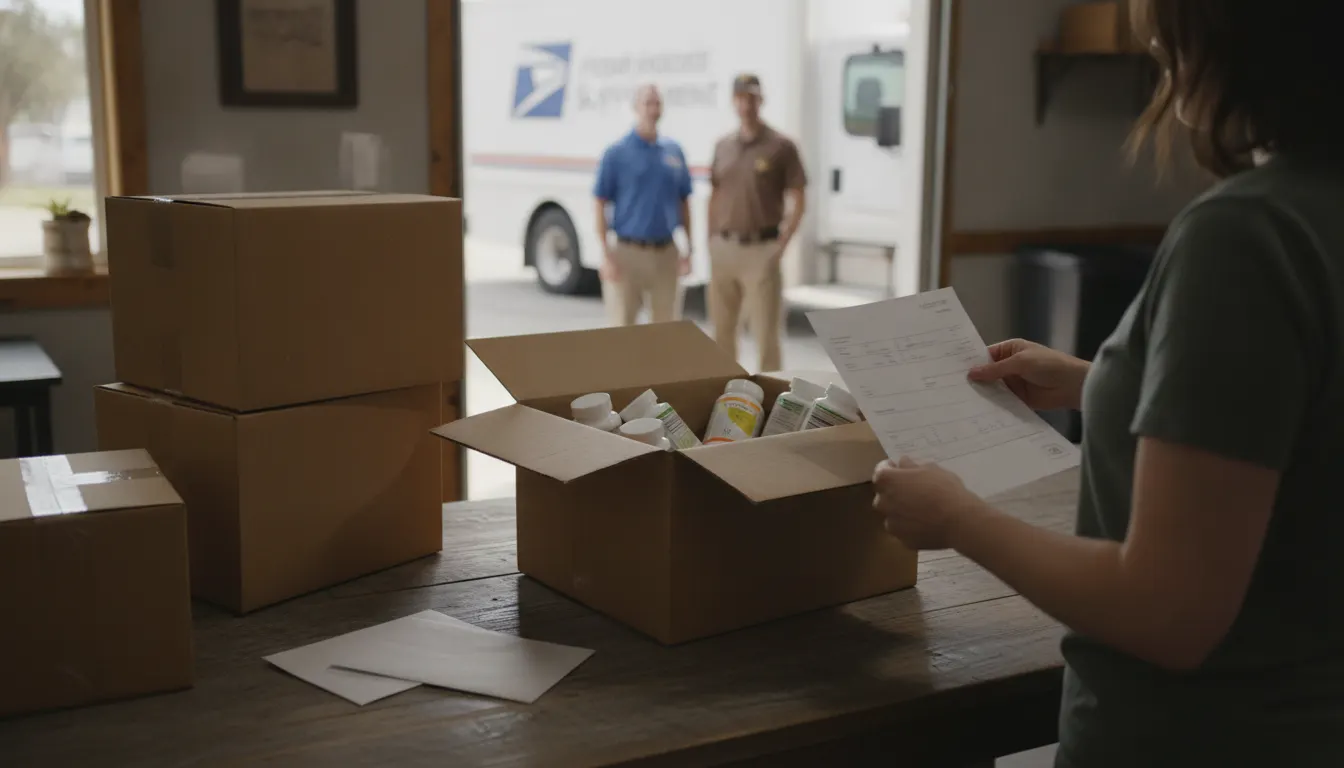
Yes, you can mail vitamins and dietary supplements in the United States with USPS, UPS or FedEx; liquids, CBD products and drugs have extra rules.
Ordinary vitamins in pill, capsule or gummy form ship like any other merchandise. Liquids and powders need leakproof or sift-proof packaging, hemp and CBD (cannabidiol) supplements have their own carrier rules, and international shipments need a customs form and must meet the destination country's import rules. Every rule below was checked on the carrier's or regulator's own page on October 25, 2026.
Can you send vitamins with USPS, UPS and FedEx?
Yes. None of the carrier policies we checked restricts ordinary vitamins or supplements, but liquids, hemp and CBD products, and drugs have extra rules.
| Carrier | Ordinary vitamins and supplements | Liquids and powders | Hemp and CBD supplements |
|---|---|---|---|
| USPS | Mailable; no Publication 52 restriction on supplements | Nonhazardous liquids mailable if packaged per section 451.3; powders in sift-proof containers | Domestic only, 0.3% THC or less, with compliance records kept 3 years; prohibited in international and APO/FPO/DPO mail |
| UPS | No vitamin or supplement entry on the UPS prohibited items list | Standard packaging; hazardous ingredients follow UPS hazardous materials rules | Restricted: accepted on a contractual basis, with Adult Signature Required within the U.S. |
| FedEx | FedEx lists supplements among the healthcare products it ships | Standard packaging; FedEx offers room temperature, refrigerated and frozen options for sensitive products | Not addressed on the FedEx pages we checked; ask FedEx before shipping |
Are vitamins treated as drugs in the mail?
Not usually. The U.S. Food and Drug Administration (FDA) counts dietary supplements as food for import purposes, while the USPS drug rules cover prescription and over-the-counter medicines.
The FDA lists "dietary supplements and dietary ingredients" among its examples of food in 21 CFR 1.276, which matters for customs (see below). USPS Publication 52 section 453.12 defines over-the-counter drugs as medicines sold without a prescription and names diet pills, cold remedies and aspirin as examples; those can be mailed if the mailer follows all applicable federal, state and local laws. Prescription medicines can only be mailed by pharmacies, practitioners and other authorized dispensers. Read our guide to mailing prescription drugs and medication if your product is a medicine rather than a supplement.
How do you pack vitamins and supplements for shipping?
Keep bottles sealed, cushion them in a sturdy box, and use leakproof or sift-proof packaging for liquids and powders.
- Pills, capsules and gummies: ship in the sealed original bottles, wrapped and cushioned so they cannot shift or crack.
- Liquid supplements: USPS Publication 52 section 451.3 requires screw caps with at least one and a half turns or another secure closure. Nonmetal containers over 4 ounces, plastic included, must be triple-packaged: absorbent material for all the liquid, a leakproof secondary bag or can, and a strong outer box. Mark the outer box with the contents and orientation arrows.
- Powders: Publication 52 section 451.2 requires sift-proof containers, or containers sealed inside a durable sift-proof outer container.
- Heat-sensitive products: pick a faster service in hot weather, or a temperature-controlled option for products that must stay cold.
Our guide on mailing liquids covers leakproof packing in more detail.
Can you mail CBD or hemp supplements?
Within the United States yes, with conditions; internationally, not through USPS.
USPS Publication 52 section 453.37 allows hemp and hemp-based products, including CBD, with a THC concentration of no more than 0.3 percent, only when the mailer follows all federal, state and local laws and keeps records such as lab test results and licenses for at least 3 years. The same section prohibits hemp and CBD in international mail and to APO, FPO and DPO addresses. UPS lists hemp and CBD as restricted items it accepts on a contractual basis, and requires UPS Adult Signature Required for shipments within the U.S. that contain hemp or hemp derivatives.
Can you ship vitamins internationally?
Yes, if the destination country allows them, the package has a customs form, and you follow that country's import rules.
USPS requires a customs form on international packages that contain goods, including mail to U.S. embassies and military bases. Describe the contents precisely (for example "vitamin C tablets, 2 bottles" rather than "supplements"); our guide on filling out a customs form walks through each field. Import rules for supplements differ from country to country, and some ask for extra paperwork. Check the destination in the Individual Country Listings of the USPS International Mail Manual, and the destination's own customs or health authority, before you ship.
Do vitamins mailed into the United States need FDA prior notice?
Usually yes. Because supplements count as food, a package of supplements mailed into the United States needs FDA prior notice, submitted before the package is sent.
Under 21 CFR 1.279, prior notice for food arriving by international mail must be submitted before the article is sent to the United States, and the Prior Notice confirmation number must appear on the customs declaration. It can be filed through the FDA Prior Notice System Interface (PNSI) or U.S. Customs and Border Protection's ACE system. The exemptions in 21 CFR 1.277 cover food carried by a traveler for personal use and food made at home and sent as a personal, nonbusiness gift, so store-bought supplements mailed from abroad are not exempt. A new rule adds the mail service name and tracking number to prior notice for international mail; the FDA says it does not expect these two fields before May 1, 2027.
Frequently asked questions
Can I mail vitamins to a friend in another state?
Yes. Sealed vitamins can go by USPS, UPS or FedEx anywhere in the United States; only hemp or CBD products and liquids have extra conditions.
Can I mail vitamins to an APO or FPO address?
Ordinary vitamins, yes, with a customs form; hemp and CBD products, no, because Publication 52 prohibits them in APO, FPO and DPO mail.
Ship supplements for less
Not sure whether an item is allowed? Check our list of restricted and prohibited items first, and find more seller guides in E-commerce Shipping Strategies. Shipixy gives you discounted UPS, FedEx and USPS rates, up to 75% off depending on the service, with no subscription fees: compare prices in the shipping calculator.
Sources
All sources were checked on October 25, 2026. Carrier policies and regulations change; the official pages below always win. This article is general information, not legal or regulatory advice.
- USPS Publication 52, section 451: liquids, powders and odor-producing materials
- USPS Publication 52, section 453: controlled substances and drugs (incl. 453.37 hemp-based products)
- USPS: international customs forms
- USPS International Mail Manual: Individual Country Listings
- UPS: list of prohibited items
- UPS: shipping marijuana, hemp and CBD
- FedEx: pharmaceutical and healthcare shipping
- eCFR: 21 CFR Part 1, Subpart I, prior notice of imported food (1.276, 1.277, 1.279)
- FDA: prior notice of imported foods