

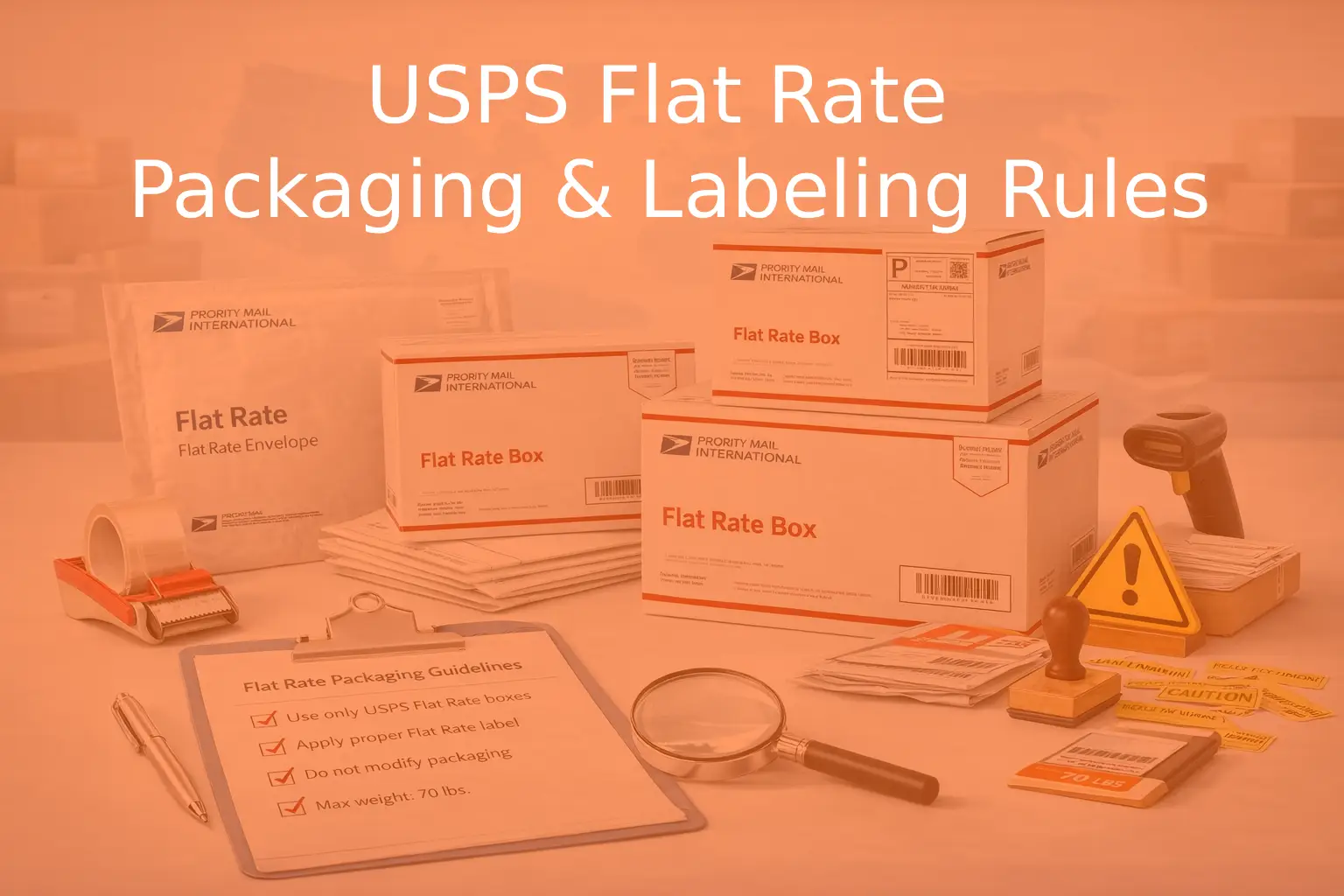



USPS Flat Rate is a Priority Mail service priced by box or envelope size, not by weight (up to 70 lbs) or distance. However, this rate applies only if you adhere to USPS's strict packaging and labeling regulations. Using the wrong box, modifying original packaging, or placing labels inaccurately may result in postage dues, delays, or rejected shipments. This guide describes the official USPS Flat Rate packaging and labeling rules so that you can package and label correctly to avoid any customs issues.
Flat Rate Packaging Guidelines
To get USPS Flat Rate pricing, you should use official USPS-branded Flat Rate boxes or envelopes. You are not allowed to use your own packaging or use Flat Rate packaging with other shipping services such as Priority Mail (weight-based), Ground Advantage, First-Class, or Media Mail. Packages should meet the USPS weight limit (maximum of 70 lbs) and adhere to all USPS mailing requirements.
Here is a complete list of rules and regulations to follow for packaging a flat-rate shipment.
- Only Use USPS Flat Rate Packaging
- Do Not Use Your Personal Boxes or Envelopes
- Never Use Flat Rate Packaging With Other Non-Flat Rate Labels
- Maximum Weight Limit is 70 pounds
- Adhere to USPS Mailing Regulations (hazardous materials and live animals regulations)
- Do not Modify Packaging
Let’s have a look at the details of each packaging requirement:
1. Only Use USPS Flat Rate Packaging
The USPS Flat Rate charge is only applied when you pack in official USPS-branded Flat Rate packaging. These are Flat Rate Boxes (Small, Medium, and Large) and Flat Rate Envelopes (Regular, Legal, and Padded).
The words Flat Rate should be printed on the packaging. Unless the container is marked Flat Rate, it cannot qualify under Flat Rate pricing. These boxes and envelopes are free of charge and available at USPS Post Offices, or you can order online at USPS.com.
2. Do Not Use Your Personal Boxes or Envelopes
Plain brown boxes, custom-branded, and any non-USPS packaging cannot be used for Flat Rate shipments. Flat Rate pricing is connected directly to USPS Flat Rate containers. In such a case, if you ship in your own packaging, even with a Flat Rate label, the shipment does not qualify for Flat Rate pricing and can be subject to extra postage or rejection.
3. Never Use Flat Rate Packaging With Other Non-Flat Rate Labels
None of the non-Flat Rate service labels can be used with Flat Rate packaging. This consists of weight-based Priority Mail, Ground Advantage, First-Class Mail, or Media Mail labels.
Although the box is marked Priority Mail, unless it is also marked Flat Rate, you must use a Flat Rate label. Mismatched packaging and labels can lead to postage due and return shipments.
4. Maximum Weight Limit is 70 pounds
The USPS Flat Rate shipments are also allowed up to 70 pounds, irrespective of the destination within the United States. This price will not change as long as the shipment does not exceed this weight limit and can be placed in the chosen Flat Rate packaging. Flat Rate service cannot be applied to any package greater than 70 pounds.
5. Adhere to USPS Mailing Regulations
USPS-produced packaging, such as Flat Rate containers, is ineligible when shipping live animals or mailable hazardous materials. This explanation is given in updates of the USPS Domestic Mail Manual (DMM).
Always make sure the contents of your Flat Rate package are mailable in accordance with USPS regulations before sending a Flat Rate package.
6. Do not Modify Packaging
Envelopes and flat-rate boxes should be used in their original form. You cannot reorganize, redesign, or drastically change the packaging. The outer cases of envelopes must not be turned inside out, and boxes must not be modified to alter their design.
Regular sealing and taping can be used, but the structural alteration might make the shipment unreliable for Flat Rate pricing.
Flat Rate Labeling Guidelines
Use a Flat Rate Priority Mail Label. The package should be labeled according to the packaging type. When shipping to international territory, military territory, or U.S. territory, all generated label pages must be attached to the address side of the package.
- Apply a Flat Rate Priority Mail Label
- Label Should Be Compatible with Packaging
- Stick the Label on the Address Side
- Do Not Change Pre-Filled Label Information
- Attach All Pages for International, Military, or Territory Deliveries
- Do Not Combine Multiple Services on the Page
Let’s have a look at the details of each labelling regulation:
1. Apply a Flat Rate Priority Mail Label
Flat Rate shipping is a form of USPS Priority Mail. In order to qualify for Flat Rate pricing, it is necessary to purchase a Flat Rate label and print it out. Normal Priority Mail label, where the postage is calculated based on weight and distance, cannot be used with flat-rate pricing.
2. Label Should Be Compatible with Packaging
The label should match the packaging type. In case you are using a Flat Rate box, then you will have to use a corresponding Flat Rate box label. When you are in a Flat Rate envelope, then you should use a Flat Rate envelope label. Poorly matched labels and packaging can lead to extra postage fees or processing time.
3. Stick the Label on the Address Side
The shipping label should be placed on the address side of the package. It must be well visible and scannable. The bar code should not be deformed. The label can be covered with clear tape to protect it, as long as it does not affect barcode reading.
4. Do Not Change Pre-Filled Label Information
The system automatically fills all the shipping information needed when creating a Flat Rate label. Once a flat rate label is created, you should not manually edit label details or change them once they are created.
Wrong modifications will lead to delivery issues. Always make sure that the address and details of the recipient are correct, and then print the label.
5. Attach All Pages for International, Military, or Territory Deliveries
In case of international deliveries, and APO/FPO/DPO military addresses and delivery to the U.S. territory, USPS creates three different label pages. The three pages are to be glued on the address side of the package.
The documents can be secured by using USPS Large Customs Declaration Form Pouches. Any failure to secure all the necessary pages can lead to delays at customs.
6. Do Not Combine Multiple Services on the Same Page
Flat rate shipment should have one valid and matching flat rate label. Flat Rate packaging cannot be used with Ground Advantage labels, or a Flat Rate can be mixed with other service markings, and old labels should not be used. To qualify under the service, each shipment should contain a properly printed and matching shipping label.
Conclusion
USPS Flat Rate charges are applicable when you package in official USPS Flat Rate packaging and apply the proper Flat Rate Priority Mail label. Adhering to these official packaging and labeling rules will avoid delays, additional postage costs, and rejected packages, making Flat Rate delivery trouble-free.


