




When goods are being shipped into the United States, they must pass through U.S. Customs and Border Protection (CBP) before they enter the U.S. CBP verifies your shipment information, paperwork, product classification, value, and any duties, taxes, or other obligations. Clearance can be processed relatively fast for a simple shipment with complete documentation, but missing documentation, incorrect HS/HTS, inspections, unpaid charges, and government agency clearance can lead to delays.
In this guide, there are step-by-step details on what documents are required, how much it costs to pay for customs clearance, how payments are made, how long it takes to clear customs, and what common customs status messages mean. You will also find out what to do if a shipment is placed on hold and what happens once it is released by CBP.
What Does the US Customs Clearance Process Mean?
The customs clearance process in the United States is handled by the United States Customs and Border Protection (CBP), which is responsible for examining goods imported to the United States. The importer or customs broker provides data on the shipment, such as product description, value, country of origin, and HTS code.
The documents are inspected, the goods are inspected, duties and fees are calculated, and requirements from other government agencies are checked. When all requirements are met and payments are made (if applicable), CBP releases the shipment for onward transport to the destination.
How Does the US Customs Clearance Process Work?
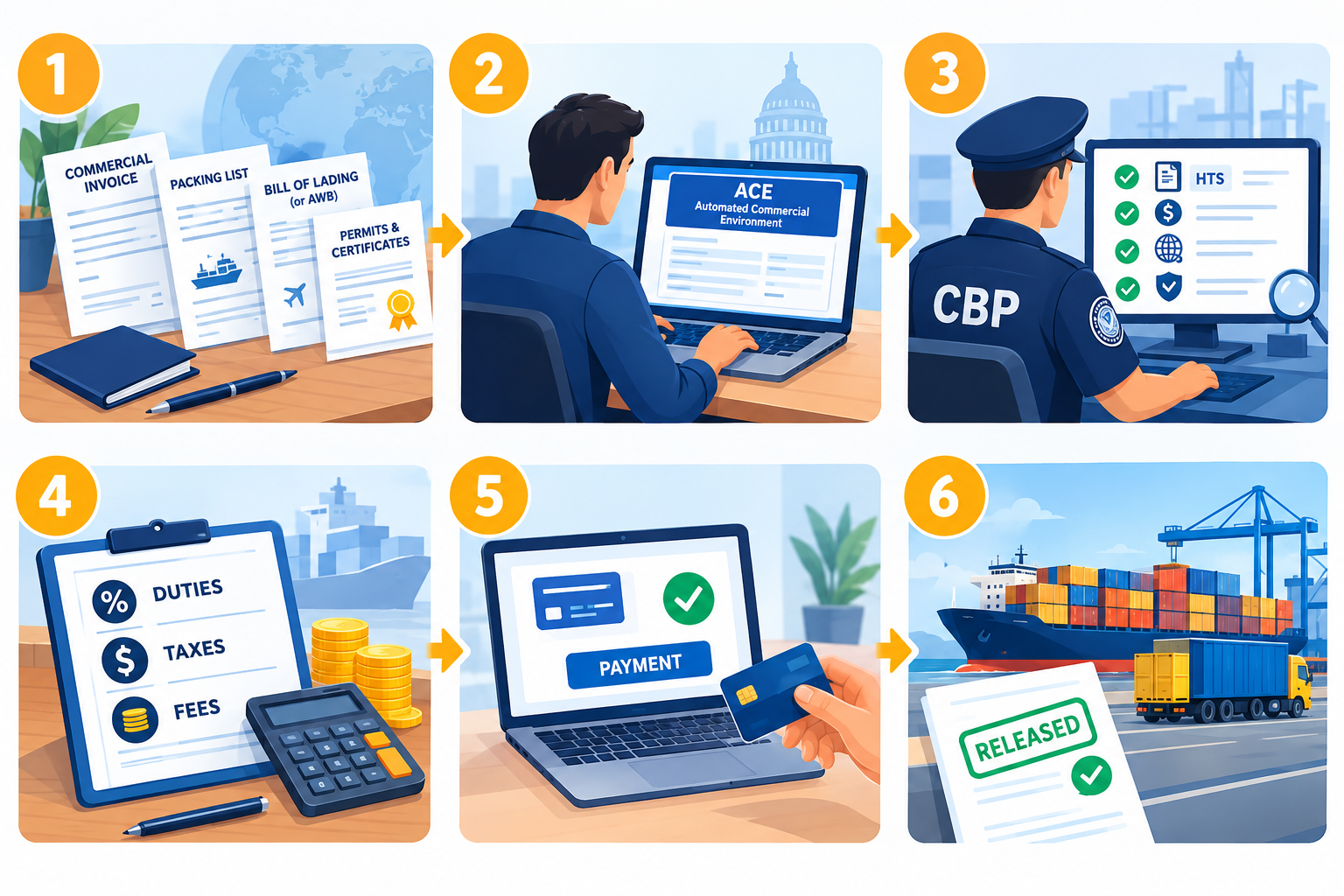
The actual process may differ depending on shipment type, value, product, and method of transportation. In general, these are the main steps:
Prepare and Complete the Customs Documents
Documentation for the shipment is gathered by the importer or customs broker. Typical documents consist of the commercial invoice, packing list, bill of lading or air waybill, and any permits or certificates that apply to certain products.
The commercial invoice must clearly state the nature of the goods, quantity, value, country of origin, and other information required for the purposes of customs classification and assessment.
File the Customs Entry
The importer or licensed customs broker files the necessary entry details with CBP, normally through the Automated Commercial Environment (ACE). The entry describes the goods imported and furnishes information that CBP uses to decide whether the goods are allowable, are classified, and what duties and fees apply.
Normally, a formal entry must be submitted when a commercial shipment is valued at more than $2,500. Some products may need formal entry, even if the value is relatively low.
CBP Reviews the Shipment
CBP inspects the paperwork when the entry is filed. It can verify HTS classification, declared value, country of origin, documentation, and regulatory requirements.
In some cases, no further action is necessary to clear the shipment. Others may be chosen for further documentation review, X-ray or physical examination, or for review by a Partner Government Agency (PGA) like the FDA or USDA.
Duties, Taxes, and Fees Are Calculated
Based on the shipment classification, value, origin, and other appropriate trade rules, CBP classifies shipments, identifies the duties and user fees, and applies them to the shipment. It can be quite different depending on the product due to differences in duty rates and other trade measures applicable to different goods. It is the importer's responsibility to make sure accuracy of the entry and the payment of duties, taxes, and fees.
Payment Is Made
If any duties, taxes, or fees are required, they are to be paid by the appropriate CBP payment process. The payment methods vary based on the entry and importer's payment configuration, including ACH.
A shipment can be held because payments for required amounts have not been received or if there is another outstanding requirement on the entry.
Customs Releases the Shipment
When all conditions are met and CBP has finished its review, the shipment is released. Messages that may be seen on Tracking include: "Released from Customs," "Customs Clearance Completed," or just "Released.
Following release, the shipment is sent to either the carrier or warehouse, and then on to the trucker or end delivery system.
How Much Does US Customs Clearance Cost?
Customs clearance fees in the United States are not a fixed amount. Total charges may include customs duty, CBP user fees, customs broker charges, examination fees, bond fees, and other charges associated with the shipment. For formal entries, the Merchandise Processing Fee (MPF) is 0.3464% of the entered value of the merchandise, with a minimum fee of $33.58 and a maximum fee of $651.50 for FY 2026.
If a formal entry is manually filed, there is a $4.03 surcharge. The price for informal entry MPF varies by entry type, ranging from $2.69 to $8.06 to $12.09 per shipment. The Harbor Maintenance Fee (HMF) is also applied to imports from the oceans which are 0.125% of the value of commercial cargo. HMF does not cover cargo imports or air or mail transport. You might also be required to pay.
How Long Does US Customs Clearance Take?
With correct classification and accurate documents, no inspection and regulatory issues, a simple shipment can be cleared for U.S. Customs in a matter of a few hours to approximately 1 business day. The standard time, however, is not guaranteed since CBP processing is dependent on the shipment, port, entry type, documentation, inspections, and other government requirements.
CBP says that formal entry processing can be variable, and some shipments may be subject to longer processing times when examined. The common reasons for delays in customs clearance are:
- Incomplete or missing documentation
- Incomplete or incorrect HTS code
- Declared value and country of origin
- Shipment type and shipment value
- CBP examination or X-ray inspection
- Review by FDA, USDA, EPA, or other PGA
- Unpaid duties, taxes, or fees
- A mismatch in data or entry errors
- Port volume and load volume
- If the entry was prepared before arrival
If the entry is set up correctly prior to the shipment, there may be fewer unnecessary delays.
What Do US Customs Clearance Status Messages Mean?
Customs tracking messages may appear confusing due to slight variations in wording between carriers and brokers. Most messages indicate whether the shipment is in process, waiting for something, on hold, or released.
- Customs Processing: Shipment is still being processed by CBP or the carrier. Does not necessarily indicate a problem.
- Customs in Progress: Customs entry has been submitted for review, but not fully processed.
- Customs Clearance Completed: Customs has completed clearance and the shipment can proceed to the next stage.
- Customs Clearance: The shipment has been released by customs. It may pass on to the carrier's distribution system.
- Import Customs Clearance Completed: The goods have passed through customs in the country of destination and are ready to proceed to delivery.
- Clearance Delay: Normal clearance is not occurring due to a problem. May be delayed due to missing paperwork, duties, regulatory requirements, etc.
- Held by Customs: Customs has stopped the shipment temporarily while an issue is reviewed or resolved.
- Documents Required: Customs or carrier requires more documents or information before clearance can proceed.
- Payment Required / Duty Pending: Duties, taxes, or shipment-related charges have not been paid.
- Inspection Required: The shipment has been chosen for inspection or for further processing.
- PGA Hold: A Partner Government Agency is reviewing the shipment. It may occur when products are regulated by agencies like FDA, USDA, EPA, etc.
- Released to Broker: Shipment is at a point in the process that the broker must take an outstanding customs or payment-related action before it is released.
- Not on File: The customs system is unable to match the information entered or the shipment. Data may need to be corrected by the broker or carrier.
- Merchandise in Bond: Goods that are under customs bond but not yet issued for unrestricted entry into US commerce.
Note: There are differences in wording across carriers, brokers, and logistics systems. Status "clearance in progress" isn't always an indication that the shipment is stuck.
Conclusion
The basic principle of the customs clearance process in the US is to declare the shipment properly, fill out the necessary paperwork, pay the correct duties and taxes, and adhere to any customs or government requirements. Delays may be caused by wrong information, missing documents, inspections, or charges not paid.
Most of the clean shipments pass through customs without major problems. Knowing what fees are being charged, how long they take, and how to track messages makes it so much easier to know what's happening and what needs to be done. Proper documentation and timely customs clearance can also minimize storage and delivery expenses for international shipments.


